Let's imagine that the price of a box of wine is £20.
To calculate the price of the wine you can use a "rule of three".
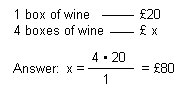
But you can also use a "conversion factor":
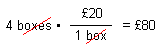
As you can see, the fraction in the conversion factor has equivalent amounts (in different units) in the numerator and the denominator. This means that we are really multiplying by one, but we obtain a different unit as the result.
To achieve this, we must put the unit that we want to transform into another in the denominator, and the unit that we want to obtain in the numerator.
The advantage of this system over the rule of three is that you can do several calculations in a single operation (we will see how in question number 6).
Use the conversion factor that you wrote down in your notebook to calculate the real price of the wine that the pub owner bought, then answer the question below.
If your answer is not correct, repeat your calculations, making sure you have the correct data; you can check your data in question 1.
IMPORTANT: write a number only, not the unit. Do not use a full stop. Example: 55
How many pounds did the pub owner pay for the wine?